
Newsletter Subscribe
Enter your email address below and subscribe to our newsletter

 ByJohn A
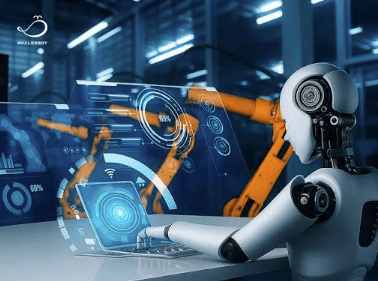
Artificial intelligence reshapes industrial robots by enhancing perception, control, and maintenance. AI-driven perception delivers reliable object recognition, motion prediction, and anomaly detection across diverse sensors. AI-enabled control adds adaptability to dynamic production floors, with auditable governance guiding decisions. Predictive maintenance lowers downtime through continuous monitoring and data-driven insights. Implementing these capabilities demands modular, validated practices and clear safety standards, ensuring interoperability with existing systems. The implications are substantial, but practical challenges demand careful, phased deployment.
AI enhances perception in industrial robotics by enabling machines to interpret and understand complex sensory data in real time.
The approach centers on structured interpretation of perception data, enabling consistent situational awareness without human bias.
Sensor fusion integrates inputs from diverse sources, increasing reliability.
This fusion supports robust decision-making, reduces uncertainty, and clarifies object recognition, motion prediction, and anomaly detection for autonomous systems.
See also: What Is a Permissioned Blockchain?
The integration of perception-driven insights with control architectures enables industrial robots to move beyond rigid precision toward adaptive performance in dynamic environments. AI-driven control enables real-time decision-making, sensor fusion, and robust feedback loops, enhancing robot autonomy while maintaining safety and reliability. Effective data governance supports auditable, compliant learning, ensuring traceability, accountability, and reproducibility across adaptive control systems.
Predictive maintenance and operations optimization with AI leverage data-driven insights to anticipate equipment failures, schedule interventions, and minimize downtime. The approach combines sensor fusion, anomaly detection, and reliability analytics to reduce disruption while preserving throughput. Data labeling ensures high-quality training data, enabling robust models. Model deployment integrates into existing workflows, supporting continuous monitoring, rapid decision cycles, and proactive maintenance planning across the manufacturing ecosystem.
Implementing AI in factory robots requires a structured, cross-functional approach that aligns technology with production goals, safety standards, and maintainability. The process emphasizes modular deployment, rigorous validation, and continuous monitoring. Practical steps include data labeling for training, defining measurable KPIs, and governance for model updates. Acknowledging edge cases ensures reliability; documentation sustains long-term interoperability and reduces operational risk.
AI regulation for safety in industrial robots hinges on harmonized safety standards, rigorous risk assessment, and conformity assessments; compliance ensures trustworthy operation, interoperability, and accountability, though evolving frameworks provoke ongoing debates about enforcement, adaptability, and где проблем?.
Ai bias risks in robotic vision include dataset skew, environmental variability, and sensor fusion gaps, leading to misclassification or unsafe actions; thorough auditing and diverse validation are essential to ensure robust, fair, and transparent robotic vision performance.
Latency-aware optimization enables AI systems to meet real-time inference challenges by balancing model complexity, hardware throughput, and pipeline latency, while employing predictive scheduling and edge computing strategies to sustain deterministic performance under variable workloads.
The ROI timeline for AI robot upgrades varies, typically 6–24 months, with payback accelerating as downtime costs fall. AI regulation for safety in industrial robots shapes compliance, risk management, and long-term value, supporting freedom through prudent investment.
Data privacy in collaborative robots hinges on data ownership and consent management. The system assigns data ownership to stakeholders, enforces consent management workflows, logs access, and applies minimization, ensuring auditable, lawful use while preserving operational autonomy and safety.
AI-augmented perception and control, underpinned by predictive maintenance, offer measurable gains in reliability, speed, and adaptability for factory robots. The approach emphasizes modular, validated deployment, robust governance, and interoperability to align with production goals. How does an integrated, data-driven loop transform a line from fixed precision to dynamic resilience, where continuous sensing, decision-making, and maintenance intersect to minimize downtime and maximize throughput? The result is a pragmatic path to persistent operational excellence.




[…] See also: Artificial Intelligence in Industrial Robots […]